Label design influences over 70% of wine purchases (Wine News/Vinitaly, 2015), so compliance requirements should enhance — not compromise — your bottle's visual appeal. This guide covers every mandatory element, the same-field-of-view rule, QR code printing specifications, and design strategies that satisfy EU requirements while preserving your brand identity. For a comprehensive section-by-section deep dive, see our Wine E-Label Masterguide.
This guide summarises EU wine label design requirements for informational purposes. For legal advice specific to your situation, consult a qualified wine law professional. Last updated: March 2026.
EU Wine Label Regulations: What's Required Since December 2023
Regulation (EU) 2021/2117, part of the Common Agricultural Policy (CAP) reform, ended wine's long-standing exemption from ingredient and nutritional labelling. Since 8 December 2023, all wines produced and sold within the EU must declare:
- Allergens on the physical label (under the word "Contains")
- Energy value on the physical label (using the "E" symbol, in kJ and kcal per 100 ml)
- Full ingredient list and complete nutritional declaration — either on the physical label or via an e-label accessible through a QR code
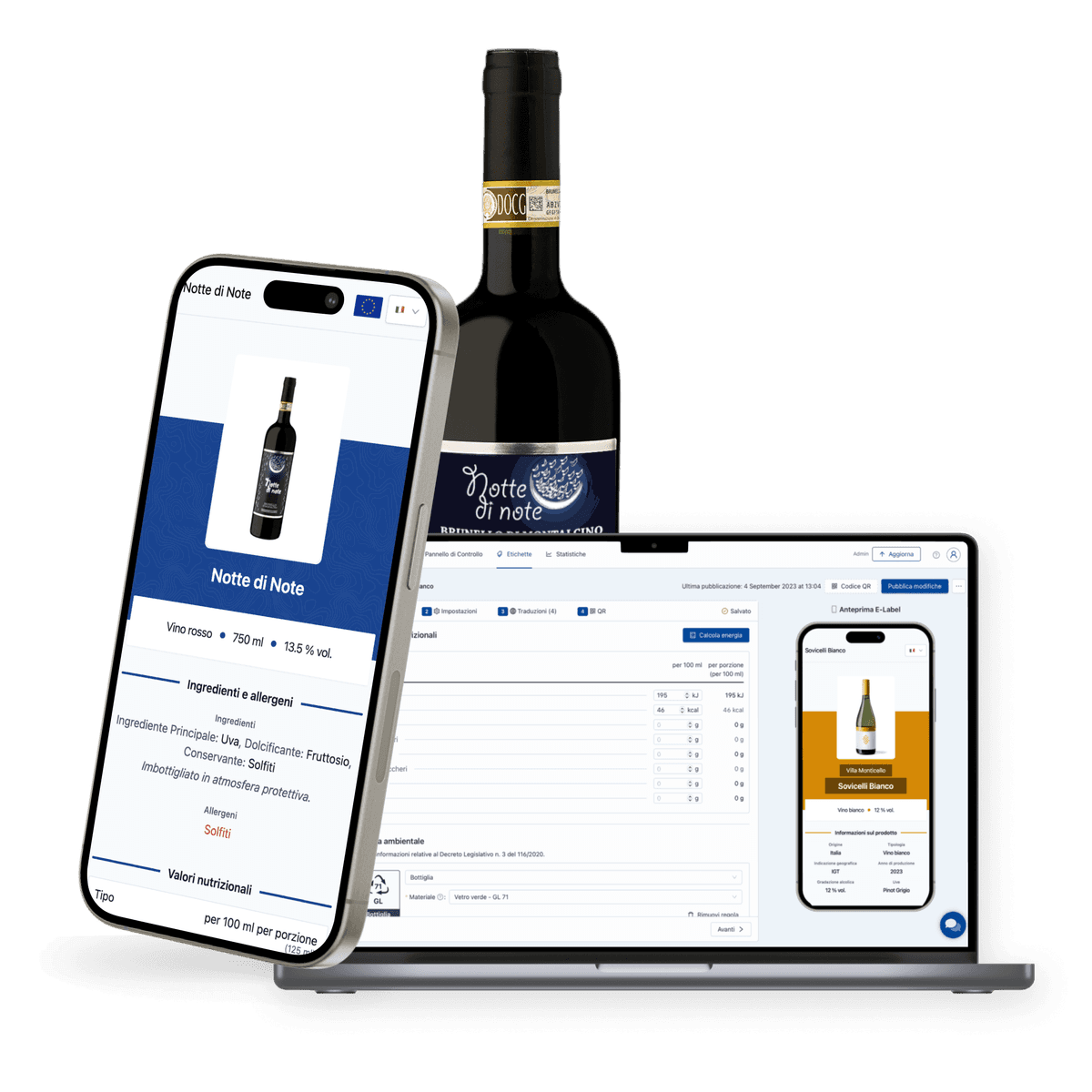
The Commission also allows the full ingredient list and nutritional table to be provided electronically, which is where QR codes and e-labels come in. This keeps your physical label uncluttered while meeting every regulatory requirement.
The 13 Mandatory Label Elements
Every wine sold in the EU must display the following on its physical label:
| # | Element | Details |
|---|---|---|
| 1 | Product category | Denomination (IGT, IGP, DOC, DOP, DOCG) in full or abbreviated form |
| 2 | Traditional mentions | Required for DO/IG wines per production regulations (e.g., Passito, Riserva, Superiore) |
| 3 | Producer/bottler | Full legal name and address. If bottled by another cellar, the ICQRF code must appear |
| 4 | Alcohol content | Actual % vol (e.g., "14.5% vol") |
| 5 | Country of origin | e.g., "Produced in Italy" |
| 6 | Vintage year | Mandatory for DOC/DOCG wines (except non-Millesimato Spumante) |
| 7 | Importer | Name and address, for imported wines |
| 8 | Sugar content | Mandatory for sparkling wines (Brut, Extra Dry, Demi-Sec, etc.) |
| 9 | Nominal volume | In cl, ml, or litres. Font size varies by bottle capacity |
| 10 | ℮ symbol | Prepackaged compliance mark, minimum 3 mm character height |
| 11 | Allergens | "Contains: sulphites" (and/or egg/milk derivatives), in the market's official language(s) |
| 12 | Lot number | Prefixed with "L" without punctuation (e.g., L1234) |
| 13 | Organic/biodynamic mark | If applicable, approved by the certifying body |
Additional mandatory elements may be specified by individual production regulations (disciplinari di produzione). Check your specific denomination's requirements.
The Same-Field-of-View Rule
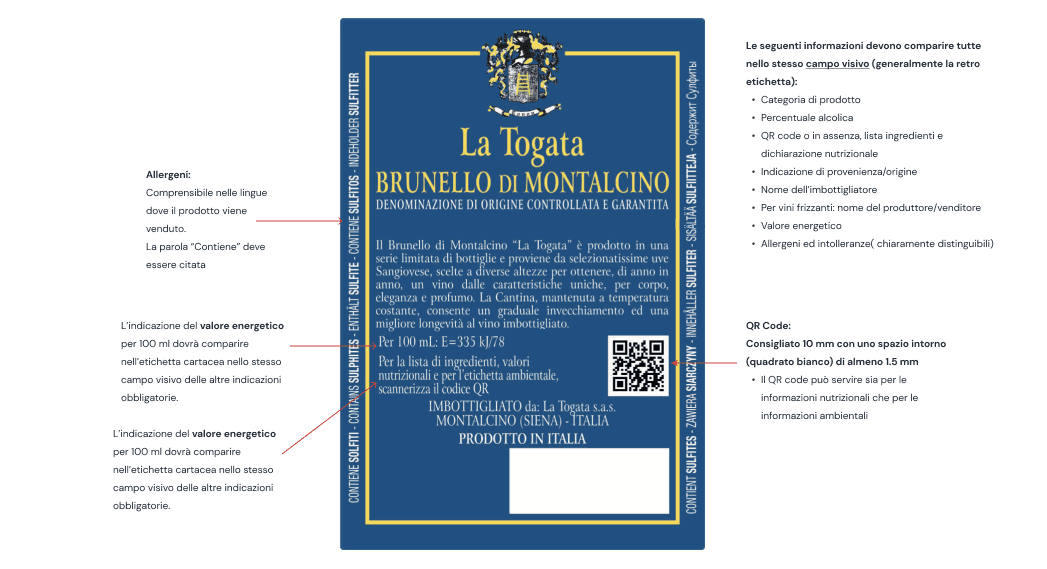
Commission Notice C/2023/1190 requires that certain mandatory information appears together in the same visual field — meaning a consumer can read it all without rotating the bottle. This is one of the most misunderstood compliance requirements.
Must appear in the same field of view:
- Product category (denomination)
- Alcohol percentage
- Country of origin / provenance
- Bottler name (or producer/vendor for sparkling wines)
- Energy value (the "E" statement)
- Allergen declaration
- QR code linking to ingredients and nutritional information
May appear outside the same field of view:
- Importer name and address
- Lot number
- Best-before date (minimum durability)
In practice, this means your back label typically carries the bulk of mandatory information in a single visual block: the denomination, alcohol percentage, origin, bottler, energy value, allergens, and the QR code with the word "Ingredients" beside it. Front labels can remain design-focused, carrying only the denomination, brand, and vintage.
QR Code and E-Label: Technical Printing Requirements
The QR code is the bridge between your physical label and the digital e-label containing the full ingredient list and nutritional declaration.
Size and Placement
The EU regulation does not prescribe a specific minimum QR code size, but best practice is 1.2 cm × 1.2 cm to 1.5 cm × 1.5 cm. For the Italian market, 1.5 cm is required. The QR code is typically placed on the back label alongside other mandatory information.
Quiet Zone
Every QR code requires a clear border (quiet zone) of at least four times the width of a single module (e.g., 1.5 mm for a 10 mm code). Without adequate quiet zone, scanning reliability drops significantly.
Colour and Contrast
Black on white provides the highest contrast (21:1 ratio) and the most reliable scanning. Dark colours on light backgrounds can work, but always test with multiple smartphone QR reader apps before production printing. Avoid light-on-dark, coloured backgrounds, or low-contrast combinations.
Resolution and File Format
Print at 300 DPI or higher. Use vector formats (SVG or PDF) for production runs — they scale without quality loss. Use PNG only for proofs or digital mockups.
The "Ingredients" Text Requirement
The QR code must be accompanied by a heading containing the word "Ingredients" (or "Nutrition/Ingredients", "Ingredients and Nutritional Values") in the language of the destination market. An "i" symbol alone is not sufficient — a change that caused significant disruption when the Commission clarified this requirement just weeks before the December 2023 deadline. The text must meet the 1.2 mm minimum font height requirement.
Energy Value on the Physical Label
When the full nutritional declaration is provided via a QR code, the energy value must still appear on the physical label. It is expressed using the letter "E" followed by the value in kJ and kcal per 100 ml:
E: 335 kJ / 78 kcal (per 100 ml)
The energy value must be in the same field of view as the other mandatory elements. The allergen declaration (e.g., "Contains: sulphites") must also remain on the physical label — the QR code does not replace these two elements.
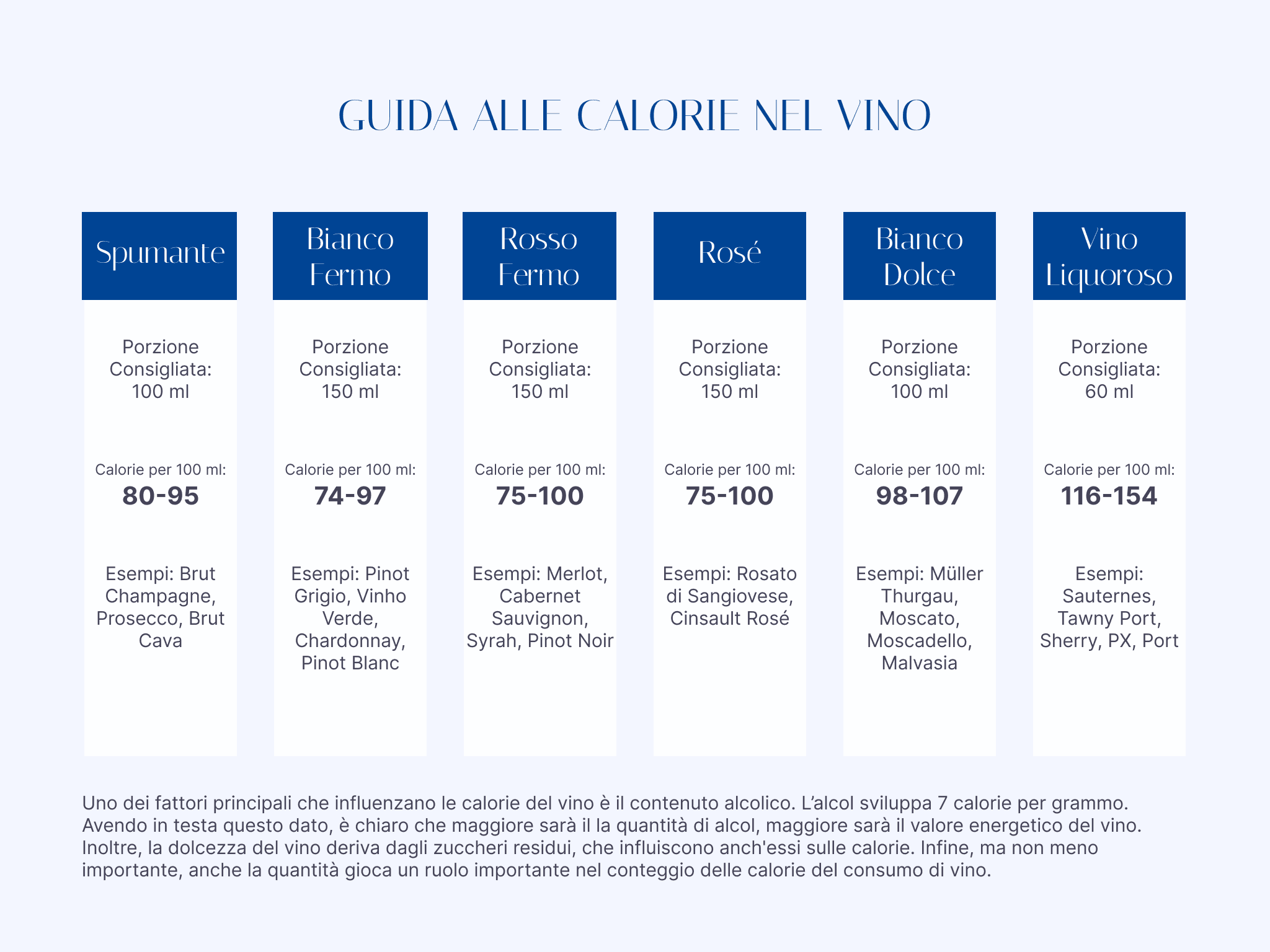
For details on how energy values are calculated from alcohol content, residual sugar, and other components, see our wine calorie calculation guide.
Environmental Labeling: Italy-Specific Requirements (D.Lgs. 116/2020)
Since January 2023, Italy's Legislative Decree 116/2020 requires all packaging sold on the Italian market to display material identification codes and recycling disposal instructions. This applies to every component of wine packaging:
| Component | Material Code | Disposal |
|---|---|---|
| Glass bottle | GL 70 | Glass recycling (vetro) |
| Cork | FOR 51 | Organic waste or unsorted (varies by municipality) |
| Aluminium capsule | ALU 41 | Metal recycling (alluminio) |
| Cardboard box | PAP 21 | Paper recycling (carta) |
| Plastic shrink wrap | LDPE 4 | Plastic recycling (plastica) |
Penalties for non-compliance with D.Lgs. 116/2020 range from EUR 5,200 to EUR 40,000.
This is one area where e-labels add significant value: rather than printing recycling pictograms and instructions on the physical label (consuming precious space), the QR code can link to an e-label page that includes both the EU-required ingredient and nutrition information and the Italian recycling instructions. QRFox.eu E-Labels supports Italian environmental labeling through the same QR code, avoiding the need for additional labels or separate recycling symbols on the bottle.
For wineries exporting to Italy from other EU countries, this is a requirement that catches many producers off guard. Check whether your e-label provider handles Italian recycling labels — most do not.
Enforcement: What Happens If Your Label Is Non-Compliant
Penalties for wine labelling violations are administered by each EU member state:
| Country | Authority | Fine Range | Notes |
|---|---|---|---|
| Italy | ICQRF | EUR 250–5,000 per infringement | Under Legge 238/2016, Art. 74. Sales stops and recalls possible |
| Italy | (environmental) | EUR 5,200–40,000 | Under D.Lgs. 116/2020 for missing recycling labels |
| France | DGCCRF | EUR 3,000–300,000 | Daily penalties for continued non-compliance |
| Other EU | National authorities | Varies | Enforcement under national legislation; market removal under Reg. 1308/2013, Art. 90a |
Beyond fines, non-compliant wines can be removed from the market and subject to product recalls — a far more costly outcome than the fines themselves. The DGCCRF in France has reported significant rates of labelling non-compliance during inspections, and enforcement is increasing across all member states as the regulation matures.
Design Best Practices for Compliant Wine Labels
Compliance doesn't mean your label has to look like a regulatory document. The key is structuring your label to separate the brand story (front) from the regulatory information (back).
Front Label Strategy
Keep the front label brand-focused: denomination, winery name, vintage, and any distinctive design elements. The front label is your marketing canvas — it drives the purchasing decision.
Back Label Strategy
Concentrate mandatory elements in a single, well-organised block: energy value, allergens, origin, bottler, alcohol %, and the QR code with "Ingredients" text. Use a clear hierarchy: the QR code and allergen statement should be prominent, with supplementary information in smaller (but still ≥ 1.2 mm) text.
Typography
- No mandatory text smaller than 1.2 mm x-height
- Choose easily readable fonts — decorative scripts are fine for the brand name but not for regulatory text
- Ensure sufficient contrast between text and background (dark text on light, or vice versa)
Design Styles That Work
- Classic: Calligraphic fonts, vintage illustrations — common for historic estates
- Modern: Clean lines, geometric shapes, bold colour — appeals to younger consumers
- Minimalist: Focus on typography and white space — maximises room for mandatory elements
- Typographic: Font-driven with no illustrations — clean and regulation-friendly
Brand Customization on E-Labels
Your e-label doesn't have to be a generic white page. With QRFox.eu E-Labels, you can customise the colour scheme, upload your logo, and add an image for each label — while remaining fully compliant with the no-marketing requirements of the regulation. This extends your brand experience from the physical bottle to the digital label, reinforcing trust and recognition when consumers scan the QR code.
Getting Compliant
Designing a compliant wine label is manageable when you separate the regulatory requirements from the creative design. Use the physical label for brand impact and the mandatory minimum (allergens, energy, key identifiers), and let the e-label handle the detailed ingredient list and nutritional declaration.
Create your first compliant e-label free — no credit card required. For a complete walkthrough of every compliance detail, see the Wine E-Label Masterguide.